Spring loaded Side Stays
All original text and images from: https://www.rclandsailing.com/design.html#wheel
LS Mast System
Since I've heard quite a few questions about my spring loaded side stays I've provided a short description below.
The spring loaded side stays themselves are a relatively simple system of lines and fatigue resistant rubber bands that allow the sail to lean to leeward. By adjusting the pre-tension in the system, the amount of lean can be adjusted. One benefit of this system is that in sudden gusts, the sail leans to leeward and naturally spills wind to prevent capsizing. You can think of this as reducing the effective sail area. This is illustrated in the accompanying figure. As the mast leans over an angle theta, the effective sail area becomes the actual sail area multiplied by the cosine of the angle.
As it turns out, I've found that model performance is also very dependent on rig tension. Specifically, the model is much faster when the sail leans to leeward. This behavior is much harder to explain, but I'll try.
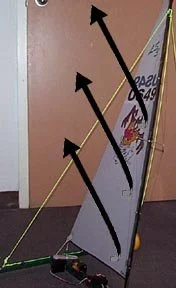
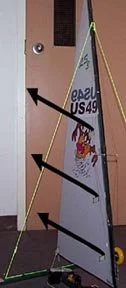
These figures try to show the difference in the vectors of the air flow over the sail for a vertical and tilted configuration.
With the sail vertical, the air is forced to flow approximately parallel to the foot of the sail so that the resultant forces on the model are to leeward (which causes sliding) and forward (to cause forward acceleration).
When the sail is leaning to leeward, the air flows upwards and to leeward (parallel to the mast). That results in two forces down and to windward that weren't present when the mast was vertical. This additional force to windward (which counteracts the leeward force and improves balance) may explain the better performance of the tilted rig.
We are copying and repeating this info in case the original site disappears…..